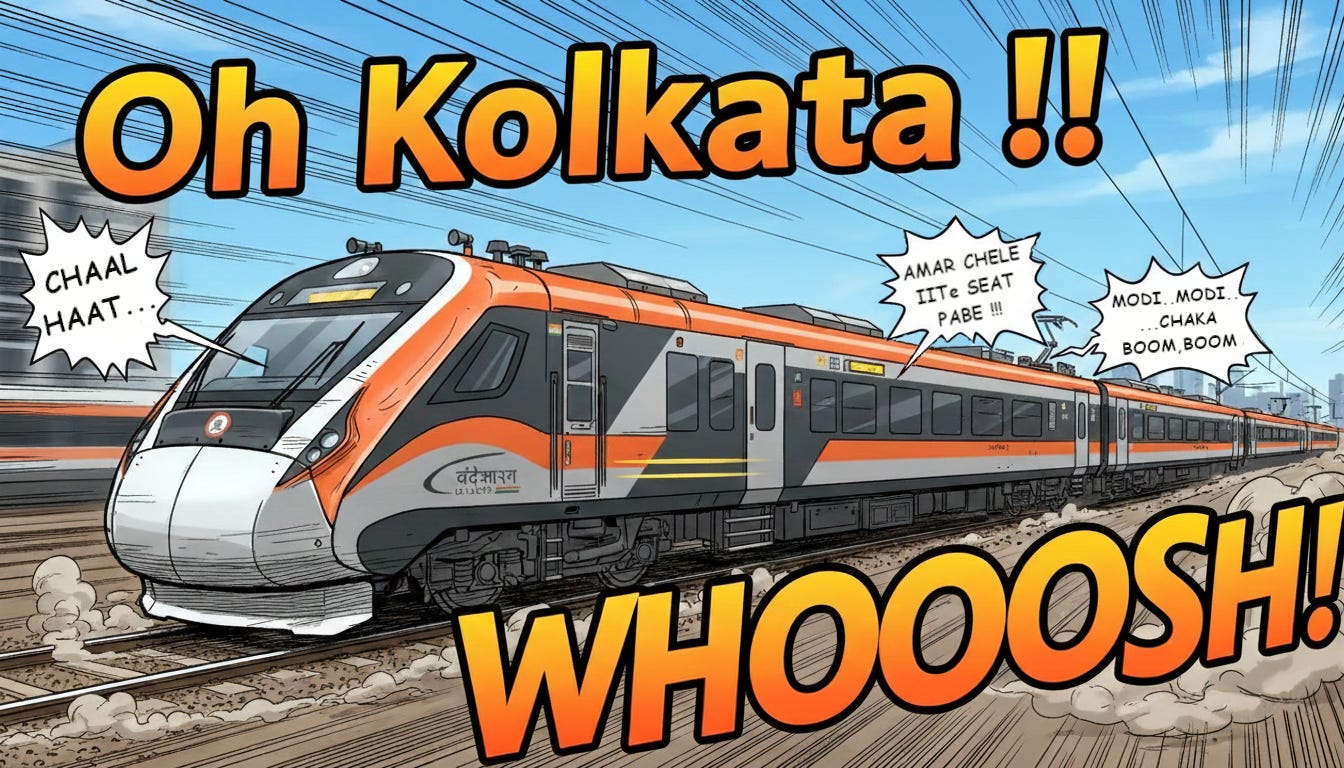
After a little over a year, I could finally leave my hometown and board a train, perhaps after half a decade. It was the new Vande Bharat overnight service to Kolkata - Indian Railways’ latest flagship and the country’s first high-speed sleeper train. Certainly the most modern thing on rails in India, with interiors almost at par with new Chinese trains, though not quite there yet. The travellers, however, were mostly unchanged - yelling across the wagon, playing music, or watching news and clips on mobiles at full volume. If some wore headphones, it took care of the input, not their vocal cords.
The train was new and clean, inside and out. The linen was fresh and crisp. It travelled quite fast for an Indian train, and almost everything worked, except the bathroom occupancy lights. They glowed green at all times, which meant anyone inside had to bear the indignity of the doorknob being repeatedly rattled by people attempting to enter, especially while they were relieving themselves.
The Wi-Fi did not work either, and the infotainment portal on the mobile opened to a large image of Prime Minister Modi on the dashboard. It offered a handful of patriotic songs, a B/W Disney adaptation of 20,000 Leagues Under the Sea, and a rather funky Japanese alien invasion film from the same period.
The food, too, was pathetic - perfectly in line with railway standards.
My companions in the three-tier coach were six polite young men, apparently from various branches of the armed forces, travelling on leave and out of uniform. There was also one middle-aged woman who, from the onset, carried herself with hostility toward the surrounding “patriarchy.” When I passed her a water bottle distributed to passengers, she snatched it with a jerk, without a word of thanks, and looked away. From her many phone calls, I gathered that she worked at a city college.
Later, a sizeable Amazon in police uniform entered carrying a chart and asked her name. After ticking it off and glaring disdainfully at the rest of us, declared that she was registering all solitary women passengers and recited for her a number as the helpline for women. The woman made a show of saving the number on her phone, but did not. The policewoman left, having discharged her duty.
That moment sealed it; rude before, now upgraded to a potential SA victim, separated from us by an invisible - though, as we would learn, not soundproof - wall.
A little later, she received a message that her son had scored above the cut-off marks in an examination that could possibly make him eligible to join an IIT (India’s apex group of government technical institutions). Thus, passing the second milestone in the pan-Indian dream of having an engineer son. She spent the next few hours calling up relatives, friends, and anyone she could think of, and was at it long after everyone else had gone to sleep. Gauging by her ecstasy and the decibels, I would have said that she was in the throes of the ultimate middle-class Bengali orgasm, but I won’t - not to offend my Bengali friends. Though most of them would concur. In any case, one look at her and any carnal associations evaporate right away.
The next morning, on arrival, I was the first to leave the compartment, nodding to the soldiers and withholding my usual courtesy of offering to help with luggage, a gesture I usually extend to women or elderly co-passengers.
Since my last visit, Howrah Railway Station in Kolkata had been connected to the Metro, making it easier to escape the overcrowded and chaotic junction, into the no less chaotic and equally overcrowded metropolis across the river. Once in the Metro, I was greeted by the sight of, for lack of a better expression, two men in drag. Not the usual eunuchs seen extorting handouts on public transport or during religious festivals. Without garish makeup, exaggerated hip sways, just dressed in printed cotton Churidar Kameez, with long hair, very large breasts, and equally deep voices. These would fit well in the city’s Bohemian fringe.
Being Kolkata, no one batted an eyelid; everyone minded their own business.
At some point, I heard a husky male voice say, “Here is a vacant seat.” From the corner of my eye, I saw one of the “they” pointing at an empty seat beside a really obese aged man. I looked around and realized I was the one being addressed. I also noticed that the “they” kept stealing glances at me coyly with a half-smile, preening “their” hair.
It seems my sex appeal remains undiminished, but as usual only for the wrong crowd.
There was only one more station to go, and with my own girth there was no way I would have squeezed into the seat beside the behemoth.
I returned a blank stare and continued standing.
It was my turn to erect an invisible wall.
Outside the Metro at Sealdah station, there was even more chaos and a larger crowd than at Howrah.
“Nothing ever changes here” was my first thought.
But again, except on my maiden visit, it has always been my first and thought whenever I stepped into or left that city.
Comments